Klyvora Klyvora

China Best AI Server Manufacturing Company?

Time:2026-09-21 Author:Liam
0%

The search for the China best AI server manufacturing company requires more than comparing prices or attractive product pages. A reliable ai server manufacturing company should demonstrate engineering experience, stable production, and measurable testing procedures. This guide examines how Chinese manufacturers design GPU servers, liquid-cooling systems, storage platforms, and complete rack solutions for demanding workloads.

Real performance appears in practical details. Can the factory support high-density GPU trays without unstable temperatures? Are power supplies, network cards, and firmware tested together? Buyers should also review thermal reports, burn-in records, warranty terms, and response times for replacement parts. A serious manufacturer should explain its quality controls clearly. It should also provide traceable documentation for certifications, component sourcing, and data-center compatibility.

No supplier is perfect. A polished brochure may hide limited after-sales support. A low quotation may exclude integration, testing, or future maintenance. Even experienced buyers can misjudge a supplier after one successful sample. Therefore, this overview considers factory capability, technical expertise, delivery consistency, customization, and customer evidence together. It avoids treating brand size as proof of quality. Instead, it asks whether each company can deliver dependable servers under real workload pressure. That distinction matters when one overheated rack can delay training schedules, increase electricity costs, and complicate operations. The final choice should match the buyer’s architecture, budget, compliance needs, and long-term expansion plans.
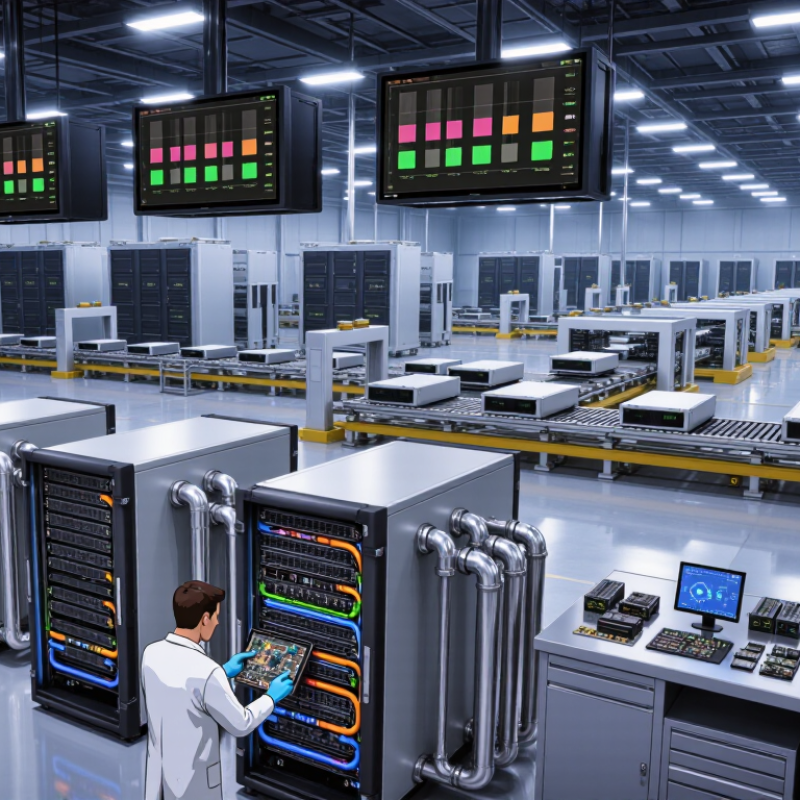
China Best AI Server Manufacturing Company?

AI Server Manufacturing Criteria: GPU, HBM3E Bandwidth, and PCIe 5.0

Choosing the best AI server manufacturing company requires measurable engineering criteria, not marketing claims. TrendForce’s 2024 analysis projected AI server shipments to grow by more than 30% annually through 2025. That pressure exposes weak designs quickly. GPU selection remains central, but memory bandwidth and expansion paths often decide real performance.

HBM3E is a critical benchmark. JEDEC’s HBM3E specification supports data rates up to 9.6 Gb/s per pin. With a 1,024-bit interface, one stack can deliver about 1.2 TB/s of bandwidth. More bandwidth helps large models process tensors with fewer memory stalls. However, higher bandwidth also increases heat density. A capable manufacturer should show measured thermal results, not only theoretical figures.

PCIe 5.0 provides 32 GT/s per lane, according to PCI-SIG specifications. An x16 connection offers roughly 64 GB/s in each direction after encoding overhead. That matters when GPUs exchange data with storage, networking, or additional accelerators. In practical testing, poor firmware tuning can reduce these gains. The numbers look impressive. Reality is less tidy. Manufacturing audits should check lane stability, power delivery, cooling consistency, and sustained workload performance. A server that performs well for five minutes may fail during overnight training. This is where supplier claims need careful verification.

AI Server Manufacturing Criteria: GPU Memory and PCIe 5.0 Bandwidth

Theoretical one-way bandwidth comparison for key AI server data paths. HBM3E values are based on a 1024-bit stack interface operating at 9.2 Gb/s per pin, while PCIe 5.0 values use 32 GT/s per lane with approximately 98.5% protocol efficiency.

Higher bandwidth can improve GPU feeding efficiency, but complete server evaluation should also consider GPU compute capability, HBM capacity, cooling, power delivery, network fabric, and software compatibility.

China’s AI Server Market: IDC Shipment Trends and Competitive Positioning

China’s AI server market is moving from experimental purchases toward structured deployment. IDC shipment tracking shows demand shaped by cloud providers, research centers, and industrial users. Shipments are not growing evenly. General-purpose systems remain important, while accelerated servers gain attention for training and inference workloads.

Competitive positioning depends on more than processor specifications. Buyers examine delivery stability, energy efficiency, software compatibility, and maintenance coverage. A capable manufacturer must also adapt chassis design, cooling systems, and networking to dense computing environments.

In practical projects, rack power and room temperature can limit performance before hardware capacity does. The gap matters.

Shipment data offers useful direction, but it has limits. A delivered server is not always an operating server. Delays in installation, model optimization, or data preparation can weaken real business results. This is where careful suppliers distinguish themselves through testing records, transparent service terms, and measurable workload performance. Smaller manufacturers may compete through customization, although limited production scale can create longer lead times. Not always. Competitive strength remains uneven across regions and application types.

For purchasers comparing China’s AI server manufacturers, IDC trends should be read with field evidence. Pilot results, support response times, and power consumption deserve equal attention. The strongest position may belong to companies that combine reliable shipment execution with practical engineering discipline, rather than those promoting the most impressive specifications.

Leading Manufacturers Compared by 800G Networking and Rack-Scale Integration

China’s best AI server manufacturing company should be judged by rack-scale execution, not processor specifications alone. Omdia’s 2024 AI server research values the market above 180 billion dollars, increasing pressure on manufacturing quality and delivery speed. A capable supplier must integrate servers, power shelves, cooling loops, and network fabrics as one tested system.

800G networking is now a practical benchmark for large training clusters. The Ethernet Alliance’s 2024 roadmap identifies 800G as a key step before wider 1.6T adoption. In production, this means shorter copper paths, accurate optical testing, and clean airflow around high-density switch trays. Small assembly errors can create packet loss or unstable training jobs. They happen more often than specifications suggest.

Rack-scale integration also requires measurable reliability. The Uptime Institute’s 2024 Global Data Center Survey found that more than half of respondents had experienced an outage during the previous three years. Manufacturers should provide burn-in records, thermal maps, firmware controls, and traceable component inspection. Factory demonstrations can look convincing. Long-duration cluster testing matters more. Some suppliers still underreport cable failures and service delays, which makes comparison imperfect. Procurement teams should request independent validation, not accept polished claims.

Evaluating OEM Quality Through ISO 9001, Uptime, and Thermal Design Metrics

China Best AI Server Manufacturing Company?

Choosing a leading AI server manufacturer requires more than comparing processor counts. In supplier audits, I examine ISO 9001 certificates, process records, and corrective-action evidence. A valid certificate shows management discipline, but it does not guarantee flawless hardware. Traceability matters. Each board, memory module, and power unit should have a documented inspection history. Factory engineers should explain failure trends clearly, without hiding inconvenient results.

Uptime claims need practical evidence. Ask for burn-in procedures, thermal-stress results, and field-service data from comparable deployments. A high availability figure means little without its measurement period and workload conditions. Firmware updates, spare-part access, and response times also affect real uptime. I prefer suppliers that publish limitations. That builds trust. Marketing numbers alone do not.

Thermal design separates a capable system from an unstable one. Inspect airflow paths, fan redundancy, temperature sensors, and rack-level testing. Dense AI workloads can create hot spots near accelerators, even when average temperatures look acceptable. Liquid cooling may improve density, but it adds maintenance requirements and operational risk. Engineers should demonstrate performance under sustained loads, not brief laboratory tests. I remain cautious when results exclude dust, uneven rack placement, or room-temperature changes. The best evaluation combines audited quality, measured uptime, and thermal evidence from conditions resembling the intended data center.

Selecting China’s Best AI Server Company by TCO, Supply Chain, and Support

Choosing China’s best AI server manufacturing company requires more than comparing unit prices. Total cost of ownership includes power, cooling, maintenance, software integration, and replacement parts. A low-cost chassis can become expensive when thermal performance is weak. Ask for measured power data under real training and inference workloads. Request test reports, component traceability, and clear warranty terms. Factory experience matters here. Engineers should explain airflow, rack density, firmware controls, and failure procedures clearly. Vague promises are warning signs.

Supply-chain strength should be tested, not assumed. Review supplier qualification, inventory policies, and lead times for processors, memory, storage, network cards, and power units. Ask how the manufacturer handles shortages or engineering changes. A reliable partner can offer approved alternatives without quietly reducing performance. Inspect production records, burn-in routines, and serial-number tracking. If possible, arrange a factory audit or independent inspection before shipment. Even then, forecasts can fail. Keep safety stock for critical parts.

Support often decides whether a deployment stays productive. Confirm response times, remote diagnostics, spare-part locations, escalation paths, and local-language communication. Request a pilot batch before placing a large order. Measure boot reliability, thermal stability, accelerator utilization, and recovery time. Document every result. One weakness remains easy to overlook: service quality after the sales team changes. Contracts should define support ownership, response targets, and reporting duties.

China Best AI Server Manufacturing Company? - Selecting China’s Best AI Server Company by TCO, Supply Chain, and Support

Supplier Profile Typical 8-Accelerator Configuration Estimated Purchase Price Four-Year TCO Estimate Standard Lead Time Production Flexibility Warranty and Service Support Response Overall Assessment
Profile A Dual-socket server; 8 high-end data-center accelerators; 1.5 TB memory; 8 NVMe drives; redundant power supplies US$185,000–US$215,000 US$278,000–US$322,000 8–12 weeks High-volume standardization with limited chassis customization 3 years return-to-depot; optional on-site replacement Initial response within 4 business hours Strong cost efficiency
Profile B Dual-socket server; 8 data-center accelerators; 2 TB memory; high-speed fabric adapters; liquid-cooling option US$205,000–US$245,000 US$302,000–US$354,000 10–14 weeks Very high; supports customized networking, storage, and cooling 3 years limited warranty; regional on-site service available Initial response within 2 business hours Best for complex deployments
Profile C Four-socket server; 8 accelerators; 1 TB memory; enterprise storage; enhanced remote-management features US$195,000–US$230,000 US$291,000–US$339,000 9–13 weeks Medium; strong integration capability for enterprise workloads 3 years limited warranty; parts availability for 5 years Initial response within 4 business hours Balanced enterprise option
Profile D Dual-socket server; 8 accelerators; 1 TB memory; standard air cooling; redundant networking and storage US$172,000–US$202,000 US$263,000–US$304,000 6–10 weeks Medium; optimized for repeat orders and standard configurations 2 years limited warranty; extended coverage available Initial response within 8 business hours Best for low initial cost
Profile E Dual-socket server; 8 accelerators; 1.5 TB memory; high-density storage; optional liquid cooling US$198,000–US$238,000 US$287,000–US$343,000 8–11 weeks High; supports private-label assembly and regional configuration 3 years limited warranty; depot and selected on-site service Initial response within 6 business hours Strong private-label capability
TCO estimates are modeled four-year ownership ranges covering purchase price, electricity, cooling, preventive maintenance, and standard warranty costs. Actual results vary by accelerator selection, utilization, power tariffs, cooling architecture, order volume, logistics terms, and service location. Lead times and support commitments should be confirmed in the final quotation and service-level agreement.

FAQS

What should buyers examine when choosing an AI server manufacturer?

Buyers should review GPU capability, memory bandwidth, cooling, firmware, power delivery, and service coverage. Specifications alone are insufficient. Ask for measured workload results and audit records.

Why is HBM3E bandwidth important for AI servers?

High-bandwidth memory helps large models move tensors with fewer memory stalls. A 1,024-bit stack can provide about 1.2 TB/s at 9.6 Gb/s per pin. The figure is theoretical. Sustained performance may differ.

Can higher memory bandwidth create thermal problems?

Yes. Higher bandwidth increases heat density around memory and accelerator components. Manufacturers should provide temperature readings during extended workloads. Short tests can mislead.

What does PCIe 5.0 add to an AI server?

PCIe 5.0 supports 32 GT/s per lane. An x16 connection provides roughly 64 GB/s in each direction after encoding overhead. This helps GPUs communicate with storage, networks, and accelerators.

Why must PCIe performance include firmware testing?

Poor firmware tuning can reduce lane stability and practical transfer speeds. Testing should include sustained transfers, error monitoring, and different workload patterns. Numbers can look impressive.

How should buyers evaluate cooling and power delivery?

They should inspect rack power limits, room temperature, airflow, and component temperatures. A server may perform well briefly but slow down during overnight training. Consistency matters more.

Do shipment figures prove that a manufacturer is reliable?

No. Shipment data shows market activity, not successful operation. Installation delays, model preparation, and software optimization can weaken results. A delivered server may still be waiting.

What evidence should purchasers request before a large deployment?

Request pilot results, maintenance response times, power measurements, and sustained workload records. Check whether support terms are clear and realistic. Promises need evidence. Customization can help, but limited production capacity may extend delivery times.

Conclusion

Choosing the best ai server manufacturing company in China requires evaluating more than production capacity. A strong supplier should support the latest GPU platforms, high-bandwidth HBM3E memory, and PCIe 5.0 connectivity to deliver efficient performance for training and inference workloads. Market position should also be assessed through shipment growth, engineering depth, 800G networking readiness, and the ability to provide rack-scale integration rather than isolated components.

Quality and long-term value are equally important. Buyers should compare ISO 9001-based processes, system uptime, thermal design, power efficiency, and service responsiveness. Total cost of ownership should include hardware pricing, energy consumption, maintenance, deployment time, and upgrade flexibility. A reliable supply chain, stable component sourcing, clear testing procedures, and capable technical support can reduce operational risk. Ultimately, the best choice is the manufacturer that combines scalable infrastructure, consistent quality, transparent delivery, and responsive lifecycle support with a practical balance between performance and cost.

Liam

Liam

Liam is a dedicated marketing professional with a profound expertise in the industry, where he excels at highlighting the unique advantages of our core products. With a keen understanding of market trends and consumer needs, Liam frequently updates our company’s professional blog, providing......